Tuesday, October 28, 2008

POSITION AVAILABLE

LIBRARIAN II – INTERNET

WASHOE COUNTY LIBRARY SYSTEM

RENO, NEVADA

The Internet Services Librarian manages the Washoe County Library System website, oversees a popular public Internet access service, helps resolve technical issues and takes part in system wide planning. Washoe County is located along the eastern slopes of the Sierra Nevada Mountains and is known as a great recreational area. This rapidly growing community has 14 library branches that include the virtual branch, the bookmobile and branches in the areas of Reno, Sparks, Incline Village and Gerlach.

Applicants must have a Masters degree from an accredited college or university in Library Science and two years of professional level library experience OR an equivalent combination of education and experience. In addition, qualified applicants will possess professional Internet experience (web design, HTML coding, training others).

Salary range $55,764 – $72,488. No state income tax; 100% employer-paid retirement contributions; medical, dental, vision, life insurance benefits provided at no cost to employee; longevity pay; and deferred compensation benefits available.

Must complete Washoe County Employment Application. For more information and access to the application form see the Washoe County Human Resources Department web site at http://www.washoecounty.us/humanresources/careers/jobs.htm or call Julie Paholke, the Recruiting Analyst at (775) 328-2085 or jpaholke@washoecounty.us

Application Deadline: Friday, November 21, 2008.

ABA Report on E-Rulemaking Proposes Overhaul of Government-Wide Program

United States-Agencies: ABA Report on E-Rulemaking Proposes Overhaul of Government-Wide Program [From U.S. Law Week, 10/28/08]

A high-level American Bar Association task force Oct. 21 released a report finding significant flaws in the federal government's effort to place all agency rulemaking dockets online and calling for a "fundamentally new approach" to the six-year, multimillion dollar project.

The task force report examined all aspects of the E-Rulemaking initiative and concluded that the project has failed to achieve its groundbreaking potential because of a series of interrelated problems involving funding, system design, and governance.

"If a government-wide electronic docket and rulemaking support system were being designed in today's technological environment, the preferred architecture almost certainly would not be a single and exclusive centralized system," the task force said in the report.

At the same time, the task force stopped short of calling for a complete reinvention of the system, calling such a move "a radical step."
Instead, it recommended that the centralized Web-based system be enhanced by allowing agencies to experiment with customized applications built off the core system, while preserving government-wide document access from a single Web site.

The goal of the 22-member task force was to provide a "clear-eyed assessment" of the current system and offer recommendations for consideration by the incoming administration and Congress, according to Sally Katzen, the task force chair, who previewed the report Oct. 17 at a meeting of the ABA's Administrative Law Section. She said she expects the ABA to endorse the report. http://www.abanet.org/adminlaw/home.html

"It is our fervent hope that this tome does not sit on bookshelves,"
said Katzen, who served as administrator of the Office of Management and Budget's regulatory policy office during the Clinton administration.

The task force report was officially released at an event sponsored by the Council for Excellence in Government. http://www.excelgov.org/

Monday, October 27, 2008

EARLY VOTING ENDS FRIDAY, OCTOBER 31ST;

LAST DAY TO REQUEST AN ABSENTEE BALLOT IS TOMORROW

Reno, Nevada Oct. 27, 2008. Washoe County Registrar of Voters Dan Burk wants to remind voters that they have until Friday, October 31st to vote early in the 2008 General Election. However, he recommends that voters try to get to an early voting location prior to Nevada Day, October 31st, as that day will probably be very busy given it is a state holiday.

Registered voters can vote at any early voting site; a listing of locations with hours of operation is located inside sample ballots which were mailed a couple weeks ago. The complete list of early voting sites can also be found by going to www.washoecounty.us/voters. Voters are encouraged to bring their sample ballot with them to make the check-in process go faster, and to bring a photo I.D. with them just in case they are required to show identification.

As of yesterday, October 26th, 51,209 people had voted early. Registrar Dan Burk had originally predicted that early voters would account for about 24% of total voters (55,000 early voters out of 225,000 registered voters). However, as of yesterday, 51,209 people had voted early, already comprising 22% of the total registered voters (231,470). With 5 more days of early voting, Burk is now predicting that early voters will comprise approximately 30% of total voters.

Absentee Ballot Requests Due Tomorrow. Voters should also be aware that if they want to vote by absentee ballot, their request must physically be in the Registrar of Voters office located in the Washoe County Administrative Complex at Ninth & Wells Streets in Reno, Nevada by 5 p.m., Tuesday, October 28th. An absentee ballot request form can be found inside the sample ballot or on our website.

Wednesday, October 15, 2008

WASHOE COUNTY REGISTERS NEARLY 25,000 ADDITIONAL VOTERS SINCE PRIMARY;

EARLY VOTING TO BEGIN ON SATURDAY, OCTOBER 18TH

Reno, Nevada. October 14, 2008. Washoe County closed its doors at 9 p.m. this evening, the last day to register to vote in the general election. The unofficial count of newly registered voters since the August primary is about 25,000.

“While we won’t have official numbers for a couple days, we do estimate that new voter registration applications total about 25,000 since the primary election,” stated Registrar Dan Burk.

Shortly after 9 p.m.---with all citizens who wanted to register to vote having been served—Registrar Burk ran a report that showed the unofficial total number of registered voters in Washoe County to be 231, 473 with 92,210 registered Democrats (39.8%) and 90,907 Republicans (39.3%)—about a half percent difference. Independent voters comprise 34,807 of the total, or 15%. In addition to the 231,473 active registered voters in the database, Burk noted that there are still 38,000 inactive voters that have not been deleted from the database but will not be included in the total registered voters number that determines voter turnout.

“While the 2004 presidential election actually had about 233,000 registered voters in our database, we know that many of those were inactive,” Burk explained. “Since that time, we’ve done a good job of cleaning up the database to reflect true active voters so the final voter turnout will truly be representative of the number of active registered voters eligible to cast their ballots.”

Throughout this last day of voter registration, the line to the Registrar’s office located at the Washoe County Administrative Complex has been steady, but not overwhelming. Additional temporary staff working the counter at the Registrar’s office helped move people through the process quicker than in past years.

“We are truly appreciative of all the cooperation we received today from both our election workers and our citizens. Everyone was very mindful of the importance of today’s process, and now we look forward to the early voting and general election events,” Burk added.

Early voting begins on Saturday, October 18th and runs through Friday, October 31st. A schedule of locations and times is available on the county’s website at www.washoecounty.us or can be found in the sample ballots. Sample ballots were mailed earlier this week, and should arrive in your mailbox by Friday. If you have any questions, please visit our website or call the Registrar’s office at 328-3670.

Tuesday, October 14, 2008


This Wednesday (October 15) the Library of Congress will offer a free online program about the history of Presidential elections and inaugurations. Details are below. Everyone is welcome to attend. There is no need to register. For more information about free online programs available through OPAL (Online Programs for All), please visit the following URL:


Wednesday, October 15, 2008 at 2:00 p.m. Eastern Time, 1:00 Central, noon Mountain, and 11:00 a.m. Pacific:
    Presidential Elections and Inaugurations: 1789 to the Present

    Host: Library of Congress

    Online Location: OPAL Online Auditorium

      The Library of Congress Web site contains a wide variety of resources that document the history of presidential elections and inaugurations. From George Washington to Obama v. McCain, learn how to navigate the Library's site to find election-related resources such as manuscripts, government documents, photographs, cartoons, films, and sound recordings.

Tuesday, September 30, 2008

DOD released their latest quarterly report on the situation in Iraq.
The September 2008 version of the "Measuring Stability and Security in Iraq" report is now available at http://www.defenselink.mil/news/d20080930iraq.pdf


The report includes various useful graphs and charts including: the production and export of oil; oil revenue; average electricity demand and production; average daily hours of electrical power by Province; weekly security incident trends; civilian deaths; ISF and US Military deaths; ethno-sectarian deaths; high profile attacks (explosions); Iraqi Security Forces numbers and more


These reports to Congress are issued in accordance with the Department of Defense Appropriations Act 2008 (Section 9010, Public Law 109-289; Section 9204, Public Law 110-252)


Previous editions of the report can be found at http://www.defenselink.mil/home/features/Iraq_Reports/index.html

Monday, September 29, 2008

SHUTTERED EPA LIBRARIES OPEN DOORS TOMORROW AFTER TWO YEARS EPA Headquarters and Chicago, Dallas and Kansas City Regional Libraries Re-Open

Washington, DC - Under orders from Congress, the U.S. Environmental Protection Agency tomorrow will again provide access to library services in
15 states and its own headquarters to agency employees and the public.
This ends a 30-month campaign by the Bush administration to restrict availability of technical materials within EPA but leaves in its wake scattered and incomplete collections under new political controls of library operations, says Public Employees for Environmental Responsibility (PEER).
On September 30th, the last day of the federal fiscal year, EPA will re-open its regional libraries in Chicago (serving the Great Lakes region), Dallas (Mid-Southern region) and Kansas City (Mid-Western region) after more than two years. In addition, a long-shuttered library in EPA Headquarters will re-open and include a small portion of holdings from what had been a free-standing Chemical Library, for research on the properties and effects of new chemicals, as a "special Chemical Collection".

In its September 24, 2008 Federal Register notice, EPA promises that these re-opened facilities "will be staffed by a professional librarian to provide service to the public and EPA staff via phone, e-mail, or in person?for a minimum of 24 hours over four days per week on a walk-in basis or by appointment."

"While we are happy that EPA is re-opening its libraries, we are disturbed that the minds which plotted their closure remain in charge," stated PEER Associate Director Carol Goldberg, whose organization first revealed EPA's plans to shut libraries and maintained a drumbeat of disclosures until Congress finally intervened and directed the agency to reverse course in December 2007. "Tomorrow, EPA will still accord its own scientists and the public less access to information than it did back in 2005."

Most of the re-opened new libraries will be housed in less space and one, in Chicago (formerly the largest regional library), will re-open without "permanent furniture and shelving." PEER notes that during the past two years, EPA further diminished its own informational infrastructure by Breaking up collections and disbursing them in a fashion that they may never be reassembled. Most of the re-opened libraries will only provide "core"
reference materials; Banning any technical holdings (called
"mini-libraries") for scientists and specialists that are not subject to centralized control; and Placing all library acquisition and management decisions under a political appointee.

In response to stinging public and congressional criticism, EPA has undertaken an elaborate "National Dialogue on Access to Environmental Information" to develop a new Library Strategic Plan in December 2008, just before the Bush administration leaves office. "Given its record, the idea that the Bush administration is now sincerely interested in expanding access to environmental information is a bit hard to take," Goldberg added.
"If Congress had not intervened, all of EPA's remaining libraries would now be on the chopping block." See the Federal Register notice on library re-openings http://edocket.access.gpo.gov/2008/E8-22468.htm

Trace the history of EPA shutting down its libraries http://www.peer.org/campaigns/publichealth/epa_library/index.php

Look at EPA attempt at "National Dialogue on Access to Environmental Information"
http://www.epa.gov/nationaldialogue/

Sunday, September 28, 2008

Sebastopol man puts code manuals online

Saturday, September 27, 2008

From a paper-choked sublet office in Sebastopol, Carl Malamud is operating a kind of nonprofit Napster, with offerings a little less sexy than the music of Metallica, Dr. Dre and Green Day.

Example: 404.1. All plumbing fixtures, other than water closets and urinals, shall be equipped with approved strainers having an approved waterway area.

That's a snippet of the 2007 California Plumbing Code, a print version of which might cost $125. But Malamud purchased the code and placed it on his Web site - and now anybody can download all 526 riveting pages free.

Or the building codes, fire codes, or mechanical codes from California, San Francisco or Los Angeles. Or millions of pages of other codes, all legally obtained by Malamud, who then uploaded them to public.resource.org for anybody to take, even though many of them are copyrighted.

"Not everybody is going to read the building code, but everybody who wants to should be able to without putting 100 bucks in the slot," Malamud said. "Primary legal materials are America's operating system."

His actions perturb government agencies, technical organizations and publishers who create, maintain and sell books of codes. While some say they do not plan to oppose Malamud's efforts, others question the legality of his site and the wisdom of his actions.

Malamud says he believes that he's on solid ground if he is sued. Some legal experts agree.

Law belongs to all

"It's very clear in American law that you can't get intellectual property protection for law," said Pamela Samuelson, co-director of the UC Berkeley Center for Law and Technology. "Law belongs to everybody."

This year Malamud persuaded the Oregon legislature not to enforce its copyright claim to Oregon Revised Statutes - after he put them online. Now he'd like to see California - and other agencies that claim copyright over public codes and regulations - do the same.

"This stuff has been locked up behind a cash register," Malamud said. "(It's) way too important to just leave it there."

If Malamud is fishing for a lawsuit - something he denies - so far nobody is biting. Officials at the agencies whose codes Malamud has posted all say they are aware of his efforts but have no plans for legal action.

Which doesn't mean those agencies are giving up their copyright - especially if someone republishes the codes for profit, said Linda Brown, deputy director of the California Office of Administrative Law.

"If somebody is going to make commercial use of that, the people of California deserve to benefit," she said.

Brown said Malamud's rhetoric is misleading - many of the codes on his site are already available free online.

The state's administrative law office Web site, for example, allows users to search the California Code of Regulations. Many other state and federal agencies do the same.

But it's not enough, said Malamud. Many of the free codes carry notices banning downloading for commercial use or downloading, printing or more-complicated options.

Free codes in future

He envisions a future where government codes are freely available in computer-friendly form to be mashed up, cross-linked, debated and redrafted by the online community.

"By liberating it, we can begin making it more useful," Malamud said. "If it costs $6 million to buy a copy of federal law ... you're not going to get somebody like Larry Page in a Stanford dorm room downloading American law and making a better version of it."

But the organizations that oversee or publish the codes appearing on Malamud's site question that claim.

"The Internet really succeeds when it's used collaboratively," said Dexter Johnson, Oregon's legislative counsel. "When laws are created by elected people, I'm not sure that model works so well."

Call it the Brittanica vs. Wikipedia debate - can online crowds be as wise as one expert? Except this debate involves laws where small details can make a difference in whether a house is constructed safely.

Codes keep changing

What's more, said California's Brown, some codes - including the California Code of Regulations - change frequently. Those changes are pushed out to people who purchase official subscriptions, but republishing sites like Malamud's may not be up to date.

Creating and updating the codes that help build safe schools, homes and offices is enormously complicated, said Michael Colopy, spokesman for the International Code Council. And the money from selling codes pays for that process.

"It is ultimately a disservice to the public if in the name of access to so-called free codes the very process that develops and enhances public safety is undermined," Colopy said. "The public is the big loser."

Malamud said he is sympathetic and willing to work with the ICC. But he argued that the ICC must grapple, like many industries, with the way the Internet is disrupting its business model.

"I think there is a lot of ways to keep that going without taking it out on the back of the kid in the pickup truck studying for the plumber's license," he said.

E-mail Matthew B. Stannard at mstannard@sfchronicle.com.

http://sfgate.com/cgi-bin/article.cgi?f=/c/a/2008/09/27/BAAH134FI4.DTL

This article appeared on page B - 1 of the San Francisco Chronicle

Wednesday, September 24, 2008

Check out Gambling on the Future: Managing the Education Challenges of Rapid Growth in Nevada
By Aaron Terrazas and Michael Fix
Nevada, the fastest growing state in the United States, is experiencing a population boom – driven in part by immigration – that has key implications for its school system and labor market. Immigrants represent one in five Nevada residents and their children account for one in three Nevadans under age 18. Yet even as schools have experienced a surge in enrollment, federal and state investments in the state's failing education system haven't kept pace at The National Center on Immigrant Integration Policy.

Wednesday, September 17, 2008

Access to Science Information Expands with Science.gov 5.0 Launch


200 Million Pages of U.S. Government Science Resources Now Available on the Internet


The latest version of Science.gov <http://www.science.gov/> -Science.gov 5.0-was launched Sept. 15th, allowing users to search additional collections of valuable science resources; more easily target their searches; and readily find links to information on a variety of science topics. Science.gov is a free, integrated single-search gateway to reliable science and technology information from 17 organizations within

13 federal science agencies.


Science.gov 5.0 improves upon the previous version, Science.gov 4.0, by offering seven new databases and portals which allow researchers access to over 200 million pages of scientific information. New information available includes thousands of patents resulting from U.S. Department of Energy (DOE) research and development(DOepatents <http://www.osti.gov/doepatents> ); documents and bibliographic citations of DOE accomplishments (DOE R&D Accomplishments Database <http://www.osti.gov/accomplishments> ); millions of electronic scientific documents from around the world known as e-prints (Eprint Network <http://www.osti.gov/eprints> ); and comprehensive and peer-reviewed toxicology data for thousands of chemicals (HSDB Hazardous Substances Databank <http://toxnet.nlm.nih.gov/cgi-bin/sis/htmlgen?HSDB>

) as well as more than 3 million references to worldwide literature on the adverse effects of chemicals on living organisms (TOXLINE Toxicology Bibliographic Information <http://toxnet.nlm.nih.gov/cgi-bin/sis/htmlgen?TOXLINE> ).  New information also includes a digital archive of biomedical and life sciences journal literature (PubMed Central <http://www.pubmedcentral.nih.gov/> ) and cancer-related information of all kinds for all audiences (Cancer.gov <http://www.cancer.gov/> ), including support and treatment resources for patients, comprehensive descriptions of research programs and clinical trials for healthcare professionals and the general public, and funding opportunities for researchers.


Another key feature of Science.gov 5.0 is a "clustering" tool which helps target searches by grouping results by subtopics or dates. This technology was recently developed through a DOE Small Business Innovation Research (SBIR) Program award.


In addition to quadrupling the amount of searchable content and enhancing the search technology, Science.gov 5.0 now provides links to related EurekAlert! Science News <http://www.eurekalert.org/>  and Wikipedia, and provides the capability to easily download research results into personal files or citation software.


Science.gov is hosted by DOE's Office of Scientific and Technical Information (OSTI), within DOE's Office of Science.  In addition to DOE, Science.gov is supported by contributing members of the Science.gov Alliance, including the Departments of Agriculture, Commerce, Defense, Education, Health and Human Services, and the Interior, the Environmental Protection Agency, the Government Printing Office, the Library of Congress, the National Aeronautics and Space Administration and the National Science Foundation, with support from the National Archives and Records Administration.


Tuesday, September 16, 2008

WASHOE COUNTY APPROVES INTERLOCAL AGREEMENT WITH CITY OF RENO FOR HOMELESS SERVICES PROVIDING MORE THAN $1 MILLION IN CASH AND IN-KIND SERVICES


Reno, Nevada. September 16, 2008. At their meeting today, the Washoe County Commission approved an interlocal agreement with the City of Reno for the operation and provision of homeless services at the Community Assistance Center (CAC) located at 315 Record Street.


The interlocal agreement is for $1,035,000 in cash and in-kind support ($240,000 in professional staff assigned to assist at the center) for fiscal year 2008-09. In addition to the $1 million-plus agreement, Washoe County had previously agreed to provide an additional $300,000 in cash for support of the construction of the Family Shelter/Resource Center Building for a total of $1,335,000 in homeless shelter support from Washoe County for fiscal year 2008-09. The $300,000 cash support is an annual commitment Commissioners made towards the Family Shelter/Resource Center Building construction and will be granted for four more years.


Key components of the agreement include:

Identifies the City of Reno as the lead entity responsible for oversight and implementation of the operation of the homeless shelters, community resource center and related services at the CAC;
Defines the term of the agreement through June 30, 2009;
Identifies that the cities of Reno and Sparks and Washoe County will cooperate in the research, planning and/or development of a 501©3 organization to take over management of the CAC;
Identifies the cooperative funding and in-kind contributions to support the CAC for fiscal year 2008-09 and any restrictions on the use of these funds.
The USCCR Report on the civil rights record of President Bush - Redefining Rights in America: The Civil Rights Record of the George W.
Bush Administration - that was mentioned in the NYT article on Saturday
- can be found on the Historical Publications of the United States Commission on Civil Rights. - http://www.law.umaryland.edu/marshall/usccr/

Monday, September 15, 2008

In Digital Age, Federal Files Blip Into Oblivion By ROBERT PEAR
Published: September 12, 2008
http://www.nytimes.com/2008/09/13/us/13records.html


WASHINGTON Countless federal records are being lost to posterity because federal employees, grappling with a staggering growth in electronic records, do not regularly preserve the documents they create on government computers, send by e-mail and post on the Web.

Federal agencies have rushed to embrace the Internet and new information technology, but their record-keeping efforts lag far behind. Moreover, federal investigators have found widespread violations of federal record-keeping requirements.

Many federal officials admit to a haphazard approach to preserving e-mail and other electronic records of their work. Indeed, many say they are unsure what materials they are supposed to preserve.

This confusion is causing alarm among historians, archivists, librarians, Congressional investigators and watchdog groups that want to trace the decision-making process and hold federal officials accountable. With the imminent change in administrations, the concern about lost records has become more acute.

We expect to see the wholesale disappearance of materials on federal agency Web sites, said Mary Alice Baish, the Washington representative of the American Association of Law Libraries, whose members are heavy users of government records. When new officials take office, they have new programs and policies, and they want to make a fresh start.


---------------------------------------


The complete article may be read at the URL above.

Tuesday, August 26, 2008

2008 FARM BILL SIDE-BY-SIDE The Food, Conservation, and Energy Act of 2008, which governs Federal farm programs for 2008-12, was enacted into law in July 2008. ERS’ side-by-side comparison of this new Farm Act with previous legislation is now available at http://www.ers.usda.gov/FarmBill/2008/. Summarized but substantive, this comparison is a time-saving reference on farm bill provisions. In addition to key provisions and details by Title, the side-by-side includes links to related ERS publications and to analyses of previous farm acts. New features include a user's guide, an A-Z list of major provisions, and a search function. Released Friday, August 22, 2008You may browse or search by topic. You'll get a table with the provisions under the previous Farm Bill, and then the provisions under the current farm bill. Below are some examples. (A search for the National Agricultural Library did not yield anything!)Examples:Grants to Reduce Methamphetamine ProductionPrevious Legislation No similar provision.2008 Farm Bill Establishes agricultural producers, cooperatives, and chemical retailers as eligible for $40-$60 grants to install locks on anhydrous ammonia nurse tanks or to add a substance that reduces methamphetamine production efficacy.Pollinator ResearchPrevious Legislation No similar provision.2008 Farm Bill Authorizes annual appropriations of $10 million in research and extension grants for honey bees and other pollinators for FY 2008-12. Activities supported include:
data collection on bee colony production and health, and investigation of pollinator biology
research on factors that contribute to colony collapse disorder, including parasites and pathogens
development of mitigative and preventive measures for pollinator health
habitat conservation and best management practices
Authorizes annual appropriations of $7.25 million for FY 2008-12 for capacity and infrastructure spending to hire personnel and conduct research on pollinator issues at USDA facilities, subject to appropriations.
Authorizes annual appropriations of $2.75 million for honey bee pest and pathogen surveillance in FY 2008-12.
Requires Secretary to submit annual report to Congress on colony collapse disorder describing progress on research and strategies for reducing colony loss. Strategies include efforts supported under the Conservation Title in this Act. (See Title II, Encouragement of Pollinator Habitat Development and Protection.)
Bioenergy ResearchPrevious Legislation Sun Grant Research Initiative Act of 2003 established Research, Extension, and Educational Programs on Biobased Energy Technologies and Products. No funds were appropriated in FY 2004 and FY 2006. However, legislation authorized appropriations of $25 million in FY 2005, $50 million in FY 2006, and $75 million annually in FY 2007-10. 2008 Farm Bill Revises Sun Grant Research Initiative; authorizes grants to 5 regionally based Sun Grant Centers and 1 subcenter intended to:
develop, distribute, and implement biobased technologies
promote diversification and environmental sustainability through biobased energy and product technologies
promote diversification of rural areas through biobased energy
enhance efficiency of bioenergy and biomass research and development through collaborations among USDA, Department of Energy (DOE), and land grant universities
Directs centers to award 75% of funds to multi-institution and multistate research, extension, and education programs via competitive process:
30% of these funds to be used for technology development
30% of funds are for integrated programs for technology implementation
20% of project costs must be matched by non-Federal source, though this requirement can be waived
limits administrative overhead costs of centers to 4%, portion of which is used to coordinate plan for addressing bioenergy, biomass, and gasification priorities of USDA and DOE, and coordinated gasification research with land grant universities
remaining funds to be retained by centers to conduct research, extension, and education programs for technology development and implementation
Grant Information Analysis Center will support regional centers and produce annual report. Authorizes $75 million annually for FY 2008-12.
Hi Amy and Valerie,
(note: I am neither a dem nor a repub and this is not a flame :-) ) I would have to respectfully disagree with your analysis. It is clear that McCain will continue Bush policies on secrecy, net neutrality, and the hyper-corporatization of the entire spectrum at the expense of things like low power FM (LPFM). It's only natural since one of McCain's chief technology advisors (and drafter of his technology
position) is former FCC Chairman Michael Powell, who vigorously worked toward selling off large swaths of spectrum to large corporations and toward changing media rules to allow for large media companies to completely take over media markets at the expense of local voices.
Their stances on "sunshine" and network neutrality are night and day and Obama's got more interesting ideas like "open source government"
and having a chief technology officer (CTO). those are just a few of the issues in which they differ and which will have a huge effect on access to govt info (and libraries in general).
lessig has a fine video regarding the presidential candidates technology policies. Granted Lessig is pro-Obama and states that at the outset, but I think he makes some good points about where the US is at in terms of technology infrastracture and where each of the candidates will take the country.
http://lessig.org/blog/2008/08/me_on_mccain_on_technology.html
On the surface, the two candidates' technology policies may be similar, but looking beyond those policy statements to take into account the candidates' advisors and their past legislative stances shows that the two candidates are at completely different ends of the policy spectrum.
Regards,
James Jacobs
International Documents Librarian
Stanford University
jrjacobs@stanford.edu

Monday, August 25, 2008

Now that both presidential candidates have gone on record with campaign positions on access to government information, we were struck by the similarity in their stated technology positions. The biggest difference that we could see is in their positions on transparency - Obama's statements appear more sunshine-friendly. Below is a summary of relevant points. Complete policies are at
http://www.johnmccain.com/Informing/Issues/cbcd3a48-4b0e-4864-8be1-d0456
1c132ea.htm
<http://mail.lib.ua.edu/exchweb/bin/redir.asp?URL=http://www.johnmccain.
com/Informing/Issues/cbcd3a48-4b0e-4864-8be1-d04561c132ea.htm> and
http://www.johnmccain.com/Informing/Issues/cb15a056-ac87-485d-a64d-82989
bdc948c.htm

(McCain) and http://www.barackobama.com/issues/technology/
<http://mail.lib.ua.edu/exchweb/bin/redir.asp?URL=http://www.barackobama
.com/issues/technology/> and http://www.barackobama.com/issues/ethics/
(Obama).
Valerie Glenn & Amy West
Universal Service
-McCain: federal support for locally built broadband access (whether public, private or mixed) as well as incentives for private companies'
extension into rural areas, auction wireless spectrum for private company expansion of broadband access to rural areas
-Obama: encourage Universal Service reform, public/private partnerships, "unleash" wireless spectrum for private company expansion of broadband access to rural areas (possibly meaning to auction spectrum)
Network Neutrality
Network Neutrality is the unprioritized transmission of content across the Internet. Because many content providers are also service providers, there exists a potential conflict over whose content gets priority in transmission. The major players in this debate are gigantic companies with massive revenue streams, e.g. Google and Comcast.
Currently, network neutrality is in place. Content/Service providers would like to be able to charge content-only providers fees to guarantee equivalent transmission of content. Content-only providers would like FCC regulations prohibiting such fees. Questions for universal service and government information: if network neutrality ended, how likely would it be that content/service providers would provide equivalent transmission to _non_-commercial content? Further, how likely is it that content-only providers would advocate for equivalent transmission of non-commercial content when they themselves have to pay for similar treatment?
-McCain: "John McCain does not believe in prescriptive regulation like "net-neutrality," but rather he believes that an open marketplace with a variety of consumer choices is the best deterrent against unfair practices."
-Obama: "Barack Obama strongly supports the principle of network neutrality to preserve the benefits of open competition on the Internet."
Government Information Online
-McCain: more information online; more business conducted electronically, more use of rich media, creation of Office of Electronic Government
-Obama: enforce universally accessible data formats, more business conducted electronically, more use of rich media, more use of participatory software to encourage citizen participation, creation of a Chief Technology Officer."
Sunshine
-McCain: greater transparency re: lobbyists, campaign funds, earmarks
-Obama: greater transparency re: lobbyists, campaign funds, earmarks, contractors; five-day public comment period (on the White House web
site) before signing any non-emergency bill; more timely release of Presidential records

Thursday, August 21, 2008

Robyn Rassuchine and Liza Printz smile for "The Gov Doc" in the young people's area of the Downtown Reno Library.

Wednesday, August 20, 2008

WASHOE COUNTY COMMISSION VOTES TO PUT CITIZEN INITIATIVE REGARDING WATER RESOURCES FOR PLANNING ON 2008 ELECTION BALLOT


Reno, Nevada. August 19, 2008. At their meeting today, the County Commission unanimously voted to place the issue of identified and sustainable water resources for planning purposes on the 2008 Election Ballot. In making their decision, all Commissioners cited that an issue of this magnitude should be put before a vote of the people.

Additionally, County Commissioners declined to introduce an ordinance initiated through a citizens petition providing that, “The Truckee Meadows Regional Plan shall be amended to reflect and to include a policy or policies requiring that local government land use plans be based upon and in balance with identified and sustainable water resources available within Washoe County,” based on the legal analysis and advice of the District Attorney’s Civil Division.

Legal counsel cited the case of Horne v. City of Mesquite where the Nevada Supreme Court ruled that the citizen initiatives were invalid because they exceeded the limits of existing laws that applied to the city believing that the same case would exist in this instance, as well as concerns raised about meeting time requirements. By state law, if the County Commission fails to adopt the certified citizen initiative as an ordinance then it must appear as a proposed ordinance question to the registered voters.

Tuesday, August 19, 2008

From Bernadine Abbott Hoduski, 312 N. Howie, Apt 1, Helena, Mt ber@initco.net
See reference to the Bureau of Reclamation library below.
From: "Public Employees for Environmental Responsibility (PEER)"
Sent: Aug 18, 2008 8:08 AM
Subject: PRESS RELEASE: Reclamation Jettisoning Environmental Functions

For Immediate Release: Monday, August 18, 2008
Contact: Carol Goldberg (202) 265-7337
RECLAMATION JETTISONING ENVIRONMENTAL FUNCTIONS
Lame Duck Reorganization Cutting Green Jobs to Promote Outsourcing
Washington, DC - The U.S. Bureau of Reclamation is rapidly downsizing its environmental capabilities by forcing scores of Denver-based specialists to go into retirement under threat of layoff, according to documents released today by Public Employees for Environmental Responsibility (PEER). This massive lame duck restructuring will force the next administration to contract for the eliminated functions.
Reclamation manages millions of acre feet of water, primarily with dams and reservoirs, in 17 Western states. Job reductions are concentrated in its Technical Services Center (TSC) in Denver where nearly one-third of the 500 jobs are now or will soon be eliminated. Among the services being cut are -
a.. Drinking Water Protection. The Expeditionary Unit Water Purification program creates potable water following disasters, such as the Hurricane Katrina aftermath, but has lost key staff;
b.. Scientists, Laboratories and Library. The Center's world renowned library and laboratories are being drained of all employees. In addition, the ax is falling heavily on science positions, such as hydrologists, soil scientists and seismologists; and
c.. Environmental Studies. Reclamation is rapidly discarding both its capacity to assess environmental effects of its water projects and its ability to analyze impacts on recreation, historical and cultural resources, as well as the social and economic consequences of its actions.
"Reclamation is taking a wrecking ball to its own workforce," stated PEER Executive Director Jeff Ruch, whose organization is distributing employee petitions to Congress asking for intervention to stop the removals. "At this rate, Reclamation will not have enough expertise left to tie its own shoes."
In a chart since removed from the Reclamation website, a "Vision TSC Staff Attrition" shows plans to cut the Center workforce nearly in half by year's end. Earlier this year, Reclamation managers targeted selected TSC employees for early retirement; an estimated 100 staff took the buyouts. Currently, another 65 employees are being targeted for new "offers" of outplacements coupled with threats of removal.
As a rationale for its personnel moves, Reclamation points to its "management for excellence (M4E)" initiative, which appears to be a thinly disguised effort to force reliance on private consultants. This expensive initiative also appears to violate congressional bans on using funds to promote outsourcing. No explanation has been given to staff why certain people are selected and others spared or what state of "excellence" will be achieved by the ME4 exercise.
"This initiative will tie the hands of the next administration and should be halted immediately," Ruch added, noting that the managers pushing the plan will soon be gone. "Reclamation already has a hyper-active revolving door for its managers, including a special side door for coming back as consultants."
Adding insult to injury, this past Friday August 15, Reclamation Commissioner Robert Johnson came to Denver to celebrate "Employee Appreciation Day," but the only relief afforded the TSC staff was a guest speaker, the "Healthy Humorist" (Dr. Brad Nieder) to deliver his message that "Laughter is the Best Medicine."
The Vanderbilt University 2008 Election page now has a tiny URL:
http://tinyurl.com/62xdwy

Tuesday, August 12, 2008

FREE LEGAL SEMINAR: “A General Overview of Social Security and disability claims”, August 28, 2008, 5:00 PM, AT WASHOE COUNTY LAW LIBRARY

Reno, Nevada. August 12, 2008. The Washoe County Law Library will host the free public legal seminar “A General Overview of Social Security and disability claims”, August 28, 2008 on Thursday, August 28th, 2008. John Boyden, Esq. will present the seminar. The seminars are held from 5 to 7 p.m. in the Law Library, located at 75 Court Street. Space is limited. Please reserve your spot by contacting the Washoe County Law Library at (775) 328-3250. The presentation is part of an ongoing series of free monthly community service seminars for the public.
FIRST WEST NILE POSITIVE MOSQUITOES FOUND IN WASHOE COUNTY

Testing of pools of mosquitoes trapped at Damonte Ranch, have shown that West Nile Virus (WNV) has found its way to Washoe County this summer. Other locations in Nevada have also seen the appearance of the virus, and the Washoe District Health Department is urging residents of our county to take precautions against being bitten by mosquitoes.
“Practicing preventive measures to reduce the chance of being bitten by mosquitoes is the best way to prevent humans from contracting the virus, stated Mary Anderson, MD, MPH, District Health Officer. Remember to use mosquito repellent containing either DEET, Picaridin or Oil of Lemon Eucalyptus, be aware that mosquitoes are most active during dusk and dawn, remove standing water from around your house and check to make sure the screens on your windows and doors fit properly.”
West Nile Virus most often is spread by the bite of an infected mosquito. Mosquitoes are WNV carriers, also known as vectors. Infected mosquitoes can then spread WNV to birds, horses, humans and other animals when they bite. West Nile Virus is NOT spread through casual contact such as touching or kissing a person with the virus.
Anderson also reminds local horse owners to get their animals vaccinated against WNV, if they haven’t done so as of yet. While pets like


dogs and cats CAN contract the virus, it is very unlikely. Do not use repellents meant for humans on pets. Check with your veterinarian for products that are pet specific. For more information, please go to our web site at www.washoecounty.us/health or to the Centers for Disease Control and Prevention at CDC.gov.

Thursday, August 07, 2008

CACI International Inc (CACI) and the National Defense University (NDU) have released a report entitled " Dealing With Today's Asymmetric Threat to U.S. and Global Security: The Need for an Integrated National Asymmetric Threat Strategy"
The report is an executive summary of a May 2008 symposium. It is hoped the report will stimulate conversation about the need to develop a new national defense and homeland security strategy which will address the threats related to everything from Islamic extremism to natural disaster.
The report can be found at
http://www.caci.com/announcement/CACI_Asymmetric_Threat_paper.pdf

Tuesday, August 05, 2008

From Larry Romans at Vanderbuilt University


My colleague Brian Boling has created a webpage for "Statistics - National Agencies and Compendia" at http://www.library.vanderbilt.edu/romans/natlstats.html
It's rather comprehensive and up-to-date.
If you have any additions or suggestions for his page, please contact
him:
brian.boling@vanderbilt.edu

Also if you have any additions or suggestions for our Election 2008 webpage (http://lib11.library.vanderbilt.edu/diglib/godort.pl?searchtext=Electio
n2008&Type=Simple&Resource=DB&Website=FDTF),
Please send them to me:
larry.romans@vanderbilt.edu
Larry
Larry Romans
Vanderbilt University Libraries
larry.romans@vanderbilt.edu
(615) 322-2838


My colleague Brian Boling has created a webpage for "Statistics - National Agencies and Compendia" at http://www.library.vanderbilt.edu/romans/natlstats.html
It's rather comprehensive and up-to-date.
If you have any additions or suggestions for his page, please contact
him:
brian.boling@vanderbilt.edu

Also if you have any additions or suggestions for our Election 2008 webpage (http://lib11.library.vanderbilt.edu/diglib/godort.pl?searchtext=Electio
n2008&Type=Simple&Resource=DB&Website=FDTF),
Please send them to me:
larry.romans@vanderbilt.edu
Larry
Larry Romans
Vanderbilt University Libraries
larry.romans@vanderbilt.edu
(615) 322-2838

Thursday, July 31, 2008

New Web Site Consolidates Access to
DoD Scientific and Technical Information
FORT BELVOIR, Va. - The Defense Technical Information Center (DTIC(r)) launches the new DTIC Online, a redesigned public Web site for Department of Defense (DoD) scientific and technical (S&T) information.
This new site integrates three of DTIC's public Web sites: DTIC Search, DTIC Home and its Public Scientific and Technical Information Network (STINET(r)).
R. Paul Ryan, DTIC's Administrator, said, "This consolidation provides DTIC customers with a single point of entry to S&T information. While the new site includes users' favorite products and resources, enhancements have been made to improve navigation and provide access to more resources in one location."
Two key features of the new site are (1) the ability to search more databases in one search and (2) Interest Area pages that provide links to pertinent information for specific S&T research communities.
With the release of DTIC Online, the MultiSearch tool has also been enhanced. This search feature assists the DoD community in accessing S&T information over a wide range of DoD, federal, commercial and international sources. DTIC customers are now able to access more than 50 database sources, from approximately 50 countries with an estimated number of 20 million documents. Sources include DTIC collections, Science.gov, the Library of Congress, World Wide Science.org, Scitopia.org and much more.
View DTIC Online at http://www.dtic.mil today. To submit feedback on the new Web site, please email: feedback@dtic.mil.
DTIC is a DoD Field Activity aligned with the Director, Defense Research and Engineering (DDR&E). The premier provider of DoD scientific and technical information, DTIC has served the information needs of the defense community for more than 60 years.

Tuesday, July 29, 2008

The Commission to Assess the Threat to United States from Electromagnetic Pulse (EMP) Attack has released their latest and it can be found along with related information at their website -- http://www.empcommission.org/index.php
Report of the Commission to Assess the Threat to United States from Electromagnetic Pulse (EMP) Attack: Critical National Infrastructure can be found at http://www.empcommission.org/docs/A2473-EMP_Commission-7MB.pdf
The EMP Commission was established as part of the National Defense Authorization Act for FY2001 and "reestablished via the National Defense Authorization Act for Fiscal Year 2006 to continue its efforts to monitor, investigate, make recommendations, and report to Congress on the evolving threat to the United States from electromagnetic pulse attack resulting from the detonation of a nuclear weapon or weapons at high altitude."
Duties of the EMP Commission include assessing:
1. the nature and magnitude of potential high-altitude EMP threats
to the United States from all potentially hostile states or non-state actors that have or could acquire nuclear weapons and ballistic missiles enabling them to perform a high-altitude EMP attack against the United States within the next 15 years;
2. the vulnerability of United States military and especially
civilian systems to an EMP attack, giving special attention to vulnerability of the civilian infrastructure as a matter of emergency preparedness;
3. the capability of the United States to repair and recover from
damage inflicted on United States military and civilian systems by an EMP attack; and
4. the feasibility and cost of hardening select military and
civilian systems against EMP attack.
The Combating Terrorism Center at West Point is pleased to announce the release of its second report of al-Qa'ida's foreign fighters in Iraq:
Bombers, Bank Accounts, and Bleedout: al-Qa`ida's Road in and Out of Iraq. The report expands on an analysis of al-Qa'ida in Iraq personnel records conducted by the CTC in December 2007. The report can be accessed at:
http://www.ctc.usma.edu/harmony/pdf/Sinjar_2_July_23.pdf
New Raw Data
Bombers, Bank Accounts, and Bleedout not only expands on the analysis of the Sinjar Records conducted in the first report, it also introduces a host of new data, including:
* Statistics on the exact number and nationality of foreign
fighters held by the US at Camp Bucca in Iraq.
* Contracts signed by AQI's foreign suicide bombers
* Contracts signed by AQI fighters entering and leaving Iraq
* Accounting sheets signed by various fighters that indicate
funding sources and expenditures
* Several narratives describing AQI's network in Syria, personnel
problems, and ties to Fatah al-Islam in Lebanon
* Weapons reports, etc.
Findings
The report has several major new findings:
* Foreign Fighters were an important source of funds for AQI;
Saudi Fighters contributed far more money than any other nationality
* Far more Syrians and Egyptians are held at Camp Bucca than were
listed in the Sinjar Records, which likely reflects the demographic shift away from those nationalities
* Approximately 75% of suicide bombings in Iraq between August
2006 and August 2007 can be attributed to fighters listed in the Sinjar Records.
* "Bleedout" of fighters from Iraq is occurring, but in relatively
small numbers. Nonetheless, these individual fighters will likely be well-trained and very dangerous. The primary threat from these fighters is to Arab states, Af-Pak, and perhaps Somalia.
* Smuggling of all kinds across the Syrian/Iraqi border has long
been linked to corruption in both Syria and Iraq, which limits both government's ability to crackdown.
* Fighters that contributed money to AQI were more likely to
become suicide bombers.

Friday, July 18, 2008

Stephen Platt, Henderson Public Library District's Government Documents Librarian amazes and astounds with his presentation at the Nevada Govdocs Training Day at the Nevada State Library & Archives.

Thursday, July 10, 2008

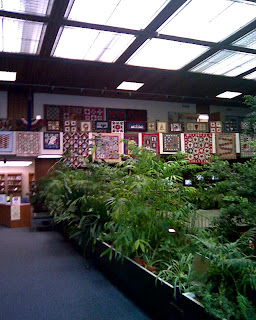
Yet, another view of the beautiful quilts on display at the Downtown Reno Library.

Wednesday, July 09, 2008

The National War Powers Commission, co-chaired by Secretaries of State Baker and Christopher, was released yesterday. This commission report recommends that Congress repeal the 1973 War Powers Resolution and "substitute a new statute that would provide for more meaningful consultation between the President and Congress. In its final report, the Commission has recommended that Congress pass a new statute, the War Powers Consultation Act of 2009, establishing a clear process on decisions to go to war."
The main website is
http://millercenter.org/policy/commissions/warpowers/
The final report can be found through the link above or directly at http://millercenter.org/dev/ci/system/application/views/_newwebsite/poli
cy/commissions/warpowers/report.pdf
And the appendices to the report can be found at http://millercenter.org/policy/commissions/warpowers/appendices

Sunday, July 06, 2008

A different view of the beautiful quilts on display in the Downtown Reno Library.

Thursday, July 03, 2008

July is quilt month at the Downtown Reno Library.

Wednesday, July 02, 2008

From Melody Kelly, Associate Dean, UNT Libraries


Today's NY Times has a lead article "China Inspired Interrogations at Guantanamo" that has govdoc research challenges hidden within its text. http://www.nytimes.com/2008/07/02/us/02detain.html?th&emc=th
For those who teach docs classes and those who keep up with the interrogation methods used by the military and CIA this article is a gem.
Hearings are an obvious source but you can also find related technical reports by Biderman http://www.dtic.mil/dtic/prodsrvc/stinet.html
And the article specifically mentioned by Biderman using our old friend PubMed http://www.ncbi.nlm.nih.gov/sites/entrez/
Don't you just love reading the newspapers!

Thank you, Melody
Rand has finally been able to release its report "After Saddam: Prewar Planning and the Occupation of Iraq."
http://www.rand.org/pubs/monographs/2008/RAND_MG642.pdf.
This report examined activities through June 2004 and part of an "eight-volume collection of reports that the RAND Arroyo Center undertook to prepare an authoritative account of the planning and execution of combat and stability operations in Iraq. Six of the volumes are classified. The other unclassified volume is being finalized."
Abstract: "This monograph begins by examining prewar planning efforts for postwar Iraq, in order to establish what U.S. policymakers expected the postwar situation to look like and what their plans were for reconstruction. The monograph then examines the role of U.S. military forces after major combat officially ended on May 1, 2003; the analysis covers this period through the end of June 2004. Finally, the monograph examines civilian efforts at reconstruction after major combat ended, focusing on the activities of the Coalition Provisional Authority (CPA) and its efforts to rebuild structures of governance, security forces, economic policy, and essential services prior to June 28, 2004, the day that the CPA dissolved and transferred authority to the Interim Iraqi Government. The authors conclude that the U.S. government was unprepared for the challenges of postwar Iraq for three reasons: a failure to challenge fundamental assumptions about postwar Iraq; ineffective interagency coordination; and the failure to assign responsibility and resources for providing security in the immediate aftermath of major combat operations."

Sunday, June 29, 2008

The Defense Department released 2 reports yesterday related to Afghanistan which look at the progress related to the country's security and its national forces. The studies were mandated by Congress to analyze results of Operation Enduring Freedom through March and are intended to include semi-annual updates. Both reports are available from http://www.defenselink.mil/pubs/
The "Report on Progress Toward Security and Stability in Afghanistan"
looks at the security environment and describes is as very "fragile."
It can be found at
http://www.defenselink.mil/pubs/Report_on_Progress_toward_Security_and_S
tability_in_Afghanistan_1230.pdf

Wednesday, June 25, 2008

The House Select Committee on Energy Independence and Global Warming and House Intelligence Community Management (ICM) Subcommittee held a joint hearing today on the "National Security Implications of Global Climate Change." The prepared statements of the witnesses have now been posted and are available at http://globalwarming.house.gov/pubs/pubs?id=0046#main_content

Wednesday, June 18, 2008

Alternative Energy - the National High School Debate Topic,
2008/09 - is up and running on the web at:
http://www.lib.umich.edu/govdocs/debate08.html
The web site has annotated links to major global warming reports, the three fossil fuels and energy alternatives ranging from hydrogen, wind, and wave to fuel cells, plug-in electric cars, and various hyrids. There are articles, research reports, laws, and Congressional hearings in full text. The Department of Energy has a truly outstanding web site, which we analyzed and supplemented with those from think tanks, automakers, state government associations, and the OECD.
Given national interest in the topic and piecemeal coverage by the media, the web team attempted to create a broad picture of the energy/environment tension, evaluate potential short and long term fixes, and define mysterious terms such as carbon sequestration.
Ray Walling (Rozkuszka Scholarship), Todd Baker and Justin Joque (both SI students) were a dream team. We spent about six weeks throwing questions at one another, like the difference between the Toyota Prius and the newest hydrogen Honda. What does methane have to do with that commercial about cows? (Not much.)
While most of us have been worrying about gas prices, it turns out that Congress has been constantly trying to address the issues and private industry has made more progress than we realized.
Grace York, Coordinator
Documents Center
University of Michigan Library
graceyor@umich.edu
(734) 764-0410
http://www.lib.umich.edu/govdocs/

Tuesday, June 17, 2008

The BIA website has announced an order to reconnect to the Internet

Court Order Permitting Internet Reconnection

Indian Affairs is now on the path to full reconnection to the Internet.
In a major development with regard to the Cobell v. Norton litigation, the United States District Court for the District of Columbia Circuit on May 14, 2008, granted defendants' motion to vacate the December 17, 2001, Consent Order Regarding Information Technology Security and has given its permission for the information technology systems of the Bureau of Indian Affairs (BIA), the Office of Hearing and Appeals (OHA), the Office of the Special Trustee for American Indians (OST), and the Office of Historical Trust Accounting (OHTA) to be reconnected to the Internet. A copy of the Court Order is attached.
The Department, and Indian Affairs has worked long and diligently to resolve the IT security issues that have concerned the Court with respect to the Department's systems housing Individual Indian Trust Data (IITD). Indian Affairs is pleased that the Court has granted this opportunity to improve our level of service to the tribes and individual Indian trust beneficiaries and to demonstrate our commitment to the protection and preservation of the IITD.
Source: http://www.doi.gov/bia/

Sunday, June 15, 2008

The House Foreign Relations Committee's Subcommittee on International Organizations, Human Rights and Oversight released today the first of 3 reports on America's International Image (covering Decline, Impact on U.S. National Interests and Recommendations).
The Decline in America's Reputation Why?
http://foreignaffairs.house.gov/110/42566.pdf
Related testimony
The Honorable Bill Delahunt,
Esther Brimmer, Ph.D., --
http://foreignaffairs.house.gov/110/bri061108.htm
Scott W. Hibbard, Ph.D., --
http://foreignaffairs.house.gov/110/hib061108.htm
John Tirman, Ph.D., http://foreignaffairs.house.gov/110/tir061108.htm
David Frum, Esq.
Webcast --
http://international.edgeboss.net/real/international/oi06112008.smi

Wednesday, June 11, 2008

The Rand counterinsurgency study reports are making the round and they have released another report in the series.
The report by Seth Jones is Counterinsurgency in Afghanistan: RAND Counterinsurgency Study - vol 4. The direct link is http://www.rand.org/pubs/monographs/2008/RAND_MG595.pdf but the page with information about it and links to the other vols and papers can be found at http://www.rand.org/pubs/monographs/MG595/ or see the list below.
A related report of interest is Analytic Support to Intelligence in Counterinsurgencies
http://www.rand.org/pubs/monographs/2008/RAND_MG682.pdf
According to the summary for Vol 4 - "This study explores the nature of the insurgency in Afghanistan, the key challenges and successes of the U.S.-led counterinsurgency campaign, and the capabilities necessary to wage effective counterinsurgency operations. By examining the key lessons from all insurgencies since World War II, it finds that most policymakers repeatedly underestimate the importance of indigenous actors to counterinsurgency efforts. The U.S. should focus its resources on helping improve the capacity of the indigenous government and indigenous security forces to wage counterinsurgency. It has not always done this well. The U.S. military-along with U.S. civilian agencies and other coalition partners-is more likely to be successful in counterinsurgency warfare the more capable and legitimate the indigenous security forces (especially the police), the better the governance capacity of the local state, and the less external support that insurgents receive."

Tuesday, June 10, 2008

From Daniel Cornwall and FGI via usa.gov


" EPA's National Dialogue on Access to Environmental Information. EPA is holding an on-line discussion among its federal partners and the public to foster collaboration on information access. Everyone is invited to use this site to identify and share their best resources, tools, and ideas for improving access to EPA's environmental information. This blog will only be accepting comments for one week - from June 9-13, 2008 - so be sure to visit and add your comments and good ideas soon!"
This ONE WEEK ONLY blog can be found at http://blog.epa.gov/partners/. I hope that anyone with an interest in environmental information will try and use this venue. - Daniel
DOD has released its FY2007 DoD Statistical Report on the Military Retirement System. It can be found directly at http://www.defenselink.mil/actuary/statbook07.pdf or from their Actuary website http://www.defenselink.mil/actuary/ . Previous reports back to
FY2001 are also available along with other reports from that office.
If you are not familiar with this report, it is pretty comprehensive providing information on all kinds/levels of military retirement information. Most is available by service and rank. While most of the stats are for the current fiscal year, there is one table for the number of military retirees receiving retired pay by year going back to 1900.
Also included are stats such as:
by State
Military Retirees outside the US
by Zip Code
by rank and current age/age at retirement/years of service by gender

Sunday, June 08, 2008

The Senate Select Committee on Intelligence has released its Phase II reports on administration misstatements on Prewar Iraq Intelligence and inappropriate intelligence activities by a Pentagon Policy Office. These reports are available from the Senate Intelligence page http://intelligence.senate.gov/pubcurrent.html or from the Chairman Rockefeller's page http://rockefeller.senate.gov/press/record.cfm?id=298774& or directly at indicated below. The press release is available at
http://intelligence.senate.gov/press/record.cfm?id=298775
Report on Whether Public Statements Regarding Iraq by U.S. Government Officials were substantiated by Intelligence Information http://intelligence.senate.gov/080605/phase2a.pdf
Report on Intelligence Activities Relating to Iraq Conducted by the Policy Counterterrorism Evaluation Group and the Office of Special Plans within the Office of the Undersecretary of Defense for Policy http://intelligence.senate.gov/080605/phase2b.pdf
The initial report is also available
Report on the Select Committee on Intelligence on Prewar Intelligence Assessments about Postwar Iraq.
http://intelligence.senate.gov/prewar.pdf

Thursday, May 29, 2008

A review of the FBI's involvement in and observations of detainee interrogations... 438 pgs.
http://www.usdoj.gov/oig/special/s0805/final.pdf
Political Appointee Asserts Control over All Libraries, Repeals 30-Year-Old Manual
Washington, DC - Ordered by Congress to re-open its shuttered libraries, the U.S. Environmental Protection Agency is grudgingly allocating only minimal space and resources, according to agency documents released today by Public Employees for Environmental Responsibility (PEER). At the same time, EPA is issuing a series of edicts placing virtually every aspect of library operations under centralized control of a political appointee.
In a May 8, 2008 e-mail to EPA employee unions, the agency announced its plan for re-opening four of the closed libraries effective September 1.
The unions were given until May 22 to reply or object. The announced plan for the Chicago library, formerly the largest regional library serving the entire six-state Great Lakes area, stipulates:
* The re-opened library will be in a vacant reception area on the
16th floor of a federal building;
* The re-opened library will occupy less than one-tenth the area
of the closed library and will be only slightly larger than the typical men's restroom in that same building; and
* No provision is made to restore the unique Great Lakes
ecological collection or to recover any of the other holdings from the former library.
Similarly, the regional library in Dallas serving a five-state area will be reduced to "2 staff workstations and 1 patron workstation, each with a PC, desk, and chair". It will be open six hours a day for four days a week. The fate of its former collection also remains unknown.
"A library requires more space than a lavatory," stated PEER Associate Director Carol Goldberg. "These plans appear to violate the Congressional order that the agency 'restore the network of EPA libraries recently closed...' What part of 'restore' doesn't EPA understand?"
Adding to the disruption caused by its 20-month library closure campaign, EPA has installed one political appointee, Molly O'Neill, the Assistant Administrator for Environmental Information, as library czar, in charge of all library operations, including those serving laboratories and specialized programs.
New rules issued by O'Neill governing every facet of library operations, including detailed directives on handling research and information requests and priorities for materials disbursal or destruction, will go into effect next month. These new rules will repeal agency protocols that have been in effect since 1977.
"Even as many collections remain in crates, EPA has decided to micromanage what is left," Goldberg added, noting that the agency has still not accounted for many of the library holdings it had removed.
"Professional librarians should be making these management decisions, not political appointees."
More information available here, including the original memo, how libraries are suppose to respond to requests and more:
http://peer.org/news/news_id.php?row_id=1051

Wednesday, May 28, 2008

Carol Lloyd, Head of Information Services at the Downtown Reno Library subs for storytime.

Sunday, May 25, 2008

CLOSED EPA LIBRARIES TO RETURN IN LAVATORY-SIZED SPACES
Web page address: http://www.peer.org/news/news_id.php?row_id=1051

Thursday, May 22, 2008

Wednesday, May 14, 2008

Announcement: It All Started With Thomas Jefferson
Posted by: "Tom Peters" tapinformation@yahoo.com tapinformation
Date: Tue May 13, 2008 7:19 am ((PDT))
Greetings! Everyone worldwide is welcome to join the librarians at the Library of Congress for this free online program about the genesis of the Library of Congress. To learn more about all upcoming OPAL free online programs, please visit
http://www.opal-online.org/progschrono.htm
Wednesday, May 14, 2008 at 2:00 p.m. Eastern Time, 1:00 Central, noon Mountain, 11:00 a.m. Pacific, and 6:00 p.m. GMT/UTC/Zulu:
From Monticello to Capitol Hill: Thomas Jefferson and His Library
Host: Library of Congress
Online Location: OPAL Online Auditorium

After nearly two centuries, Thomas Jefferson¢s library has again been recreated at the heart of the Library of Congress for all to see. How did catastrophe vie with vision and innovation to transform Jefferson¢s library into the Library of Congress? Join us as we take you on a virtual journey across the Web, blending a nineteenth-century story with twenty-first-century technical innovation to bring you online resources that are both the oldest and the newest treasures the world¢s greatest library has to share.
Tom Peters, OPAL Coordinator
TAP Information Services
1000 SW 23rd Street
Blue Springs, MO 64015
phone: 816-228-6406
email: tpeters@tapinformation.com
web: www.tapinformation.com
Skype: tapeters4466
Maxito Ricardo in Second Life
The House Committee on Homeland Security Majority Staff have published a new report examining "Public Health, Safety, and Security for Mass Gatherings." This is a comprehensive report and it includes 30 recommendations for what should be done by levels of government as well as the private sector in the event of an act of terrorism or any other from of disaster. The report is available directly at
http://homeland.house.gov/SiteDocuments/20080513105623-98169.pdf .
The press release is available at
http://homeland.house.gov/press/index.asp?ID=373

Sunday, May 11, 2008

The Senate Committee on Homeland Security and Governmental Affairs has released its majority and minority staff report entitled "Violent Islamist Extremism, The Internet, and the Homegrown Terrorist Threat."
It can be found at
http://hsgac.senate.gov/public/_files/IslamistReport.pdf or from the Committee's website http://hsgac.senate.gov/public/

Wednesday, May 07, 2008

Watching gas prices rise 15-cents overnight will frighten the hardiest of souls. Fight back with a little information.
The University of Michigan Documents Center has just launched its Gasoline Prices web page at:
http://www.lib.umich.edu/govdocs/dn08/dn08gas.html
The web page is filled with statistics on pump and crude oil prices, exchange rates, and oil reserves. Did you know there are 42 gallons to a barrel of oil? It is also addresses solutions to high prices from supply and demand to the Strategic Petroleum Reserve, a gas tax holiday, and regulating commodity exchanges. In case you are wondering, there IS no existing windfall profits tax!

Tuesday, May 06, 2008

The House Committee on Oversight and Government Reform, Majority Staff has released its report "Hospital Emergency Surge Capacity: Not Ready for the 'Predictable Surprise.'" The report is available at
http://oversight.house.gov/documents/20080505101837.pdf
For the links to the related snapshot reports for various hospitals as well as information about the hearings being held this week, go to
http://oversight.house.gov/story.asp?ID=1929 .

Thursday, May 01, 2008

The State Department has released its latest "Country Report on Terrorism." This report is required by law and until 2004 was called the "Patterns of Global Terrorism." The html version of the 2007 is now available at
http://www.state.gov/s/ct/rls/crt/2007/
Previous reports [2006-2000] can be found at http://www.state.gov/s/ct/rls/crt and the archive [1995-1999] of the earlier reports can be found at http://www.state.gov/www/global/terrorism/annual_reports.html